
— This is an extract from The Picking Garden: Grow and gather cut flowers for homegrown arrangements all year round by Jo Turner
A garden harvest
When the moment arrives to pick flowers, arm yourself with a sharp pair of secateurs and container of water. Flowers should be cut in the morning when they are well-hydrated, or in the cool of the evening.
Give your secateurs a wipe over with bleach or rubbing alcohol to keep them clean and reduce the risk of introducing bacteria to the cut.
The aim is to minimise damage and trauma to the plant and the blooms. Placing stems into water straight after cutting maintains their water supply.
When you have finished picking, take the cut flowers inside, remove all foliage that will sit below the water in a vase – leaves will rot and create bacteria when submerged, shortening the life of your cut flowers and producing water that smells bad – and re trim stems at a 45-degree angle before placing them into a clean bucket of water and leaving them to soak in a cool, dark room for at least a couple of hours.
Cutting at a 45-degree angle increases the surface area available to take up water and allows a stem to sit on its point and expose more of the cut surface to water.
The stage of development at which blooms should be picked depends on the individual flower. Those with multiple buds on each stem – salvia, delphinium, gladioli, clustered heads of agapanthus, lilac, yarrow, for example – should have at least one bud opening and another with colour showing before cutting. Flowers that grow on single stems – dahlias, sunflowers, zinnias – can be picked when part to fully open.
Placing flowers in lukewarm water will speed up opening; conversely, cold water will help blooms ‘hold’. Blooms that grow from bulbs should only ever be placed in cold water – I place ice cubes in the water when I need the arrangement to last.
—
How to get the most out of your cut flowers
Conditioning
Different flowers will need different treatment after cutting. See individual entries in this book for specific methods of conditioning.
Hearty stems
Cut at a 45-degree angle and leave to soak in lukewarm water in a cool, darkened room for at least one hour before placing in a vase.
Hollow stems
Hollow stems should be filled with water. Turn the flower upside down and pour water into the cavity of the stem. Hold your thumb over the bottom of the stem to keep the water in as you place it in a vase. Repeat this process each time you retrim stems and change the water.
Soft stems
Flowers that grow from bulbs should be cut where the green of the stem starts, just above the white of the bulb, and placed in cold water.
Woody stems
Should be split vertically to increase the surface area available for water uptake. Do not smash with a hammer, this will damage the stem’s vascular structure making it unable to absorb water.
Milky stems
Searing milky stems stops them from secreting sticky sap that may impede any other flowers in the same vase from taking up water. Dip the ends of milky stems in boiling water or hold them in a flame for 10–20 seconds. Repeat this process each time you retrim stems and change the water.
—
Searing stems
To protect the delicate petals of short-stemmed blooms from steam when dipping stems into boiling water, carefully enclose flower heads in a paper bag while scalding.
The time needed to sear stems depends on their thickness – thin green stems need only 10 seconds and sturdy woody branches 30–40 seconds – watch for when bubbles stop emerging at the base to know when a stem is seared.
—
Recipe — Homemade flower preservative
Use with every vase of flowers and replace when stems are retrimmed and water changed.
- 1 tsp sugar
- 1 tsp bleach
- 2 tsp lemon juice or vinegar
- 1 L water
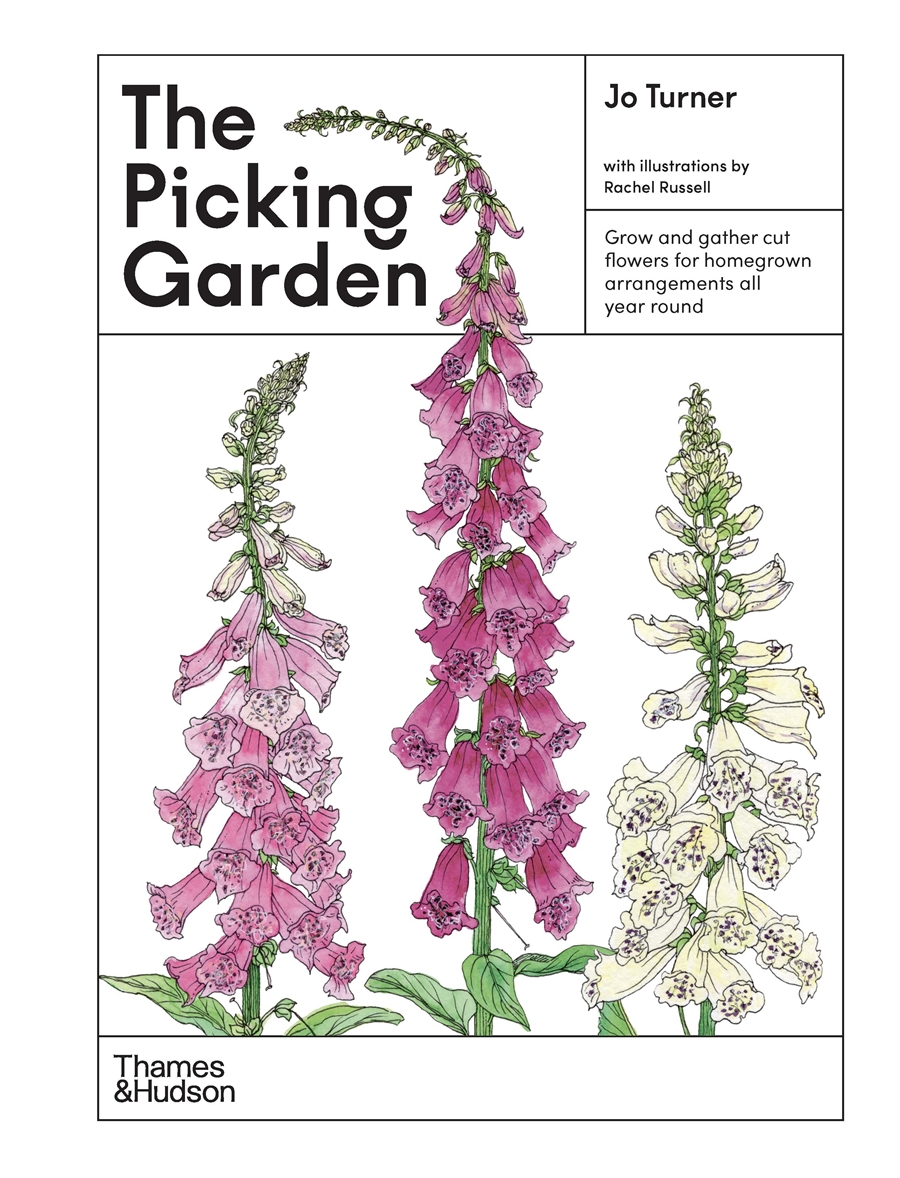
The Picking Garden: Grow and gather cut flowers for homegrown arrangements all year round by Jo Turner
The Picking Garden by Jo Turner, illustrations by Rachel Russell, published by Thames & Hudson Australia, NZD$54.99