
— Excerpt from Aotearoa in Bloom: A history, culture and practical uses of New Zealand’s flowers by Rachel Clare & Tryphena Cracknell
Tūrutu | Dianella
Lily? Flax? Flax lily? Tussock? Grass? Sedge-like? Herb? The little tūrutu (Dianella species) perennials have been tagged with all of these epithets.
There are three species endemic to Aotearoa – members of a small genus of about forty species, found across Asia, Australia, the Pacific Islands and Africa.
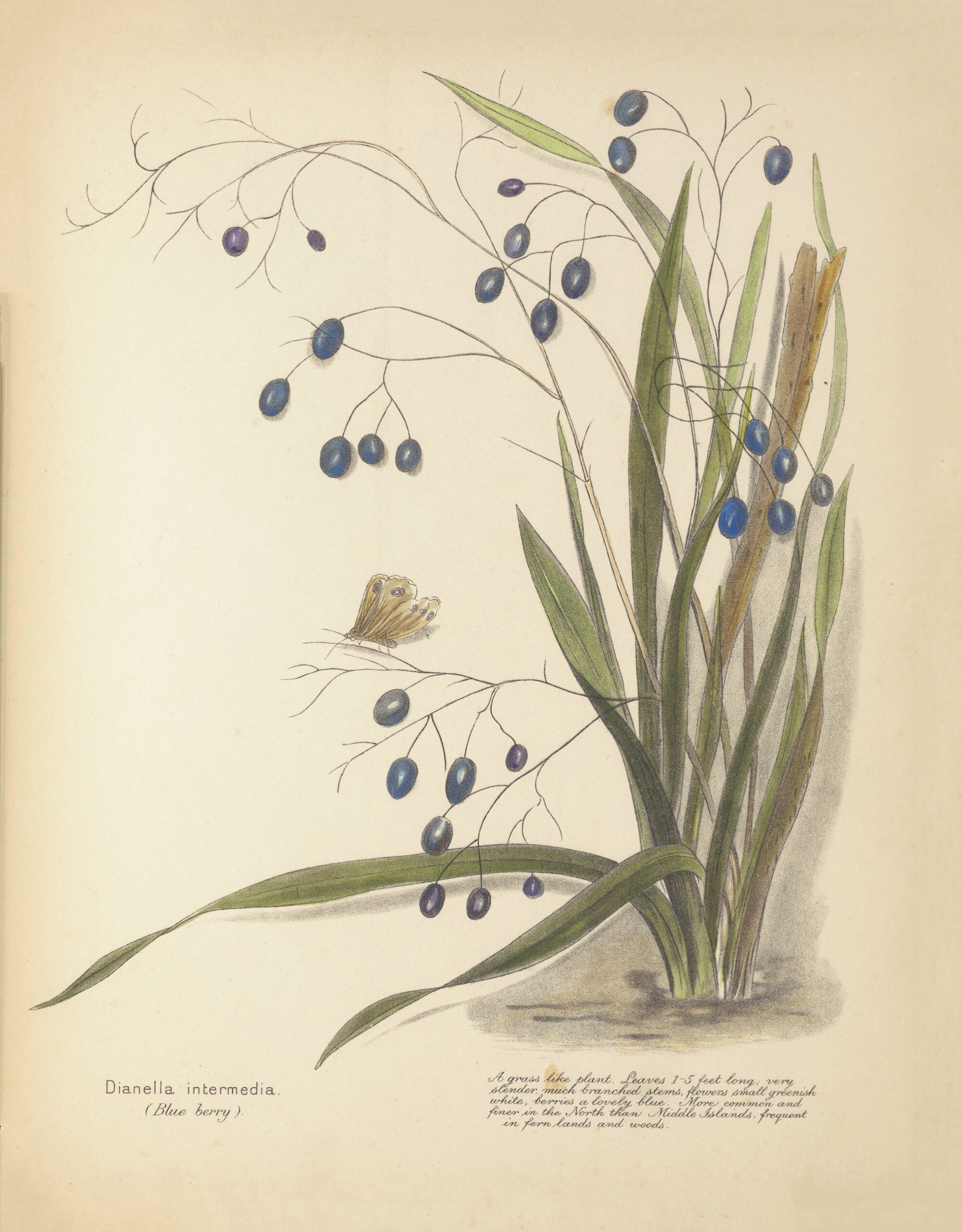
Dianella intermedia (blue berry), plate 9 from the book New Zealand berries, Miss Emily Harris, 1890, H. D. Jackson, Nelson, Te Papa, RB001329/009a
This is far from an incitement to go out and trap a kete of korimako bellbirds, but in times when native birds were plentiful, a rolled-up tūrutu leaf was used as a whistle to lure birds to a long stick known as a pae. Another stick, a whiu, was then used to do away with them.
In a 1966 Forest & Bird magazine, Marguerite Johnston shared a memory of ‘whistling through the leaf sheaths of the dianella. Very soon fantails, tomtits and riroriros would be twittering overhead, with a shy weka peeping round a tree trunk.’
Why not try and bring the birds to your own backyard? Fold a tūrutu leaf into a tube, then blow through it and see what comes flying in – just keep your whiu to yourself. A rich purple juice (due to the anthocyanin pigment) can be squeezed from the berries. In Hawaii, the native ‘uki ‘uki (D. sandwicensis), also a rich blue, is used for dyeing kapa barkcloth. The leaves are also used for thatching. New Zealand species D. intermedia (now known as D. nigra) was included in research in 1969 into a group of native plant seeds. It contains linoleic, oleic and palmitic fatty acids with possible skin-care and medicinal applications, which to date have not been pursued.
Some of the Australian species, like D. revoluta and D. caerulea are edible. Roots and leaves were used in medicinal practice and leaves were often used for making cord and ropes. An elder of the Aboriginal and Torres Strait Islander peoples reminisced, ‘Dianella, it can be revoluta or caerulea or it could be any one of the Dianellas. They all grow in the Sydney region and you could eat the fruit raw or you could cook it but I like the best part of all. And the best part of all is that we use it as lipstick to attract our males and that is we would eat some fruit and it would dye our tongues blue and our lips blue. And if we saw a very attractive male we would poke our tongues out at him and that would mean we were available.
Be berry careful
While native birds enjoy Aotearoa’s Dianella berries, do not be tempted to taste these!
Although one brave (or silly) writer reckons New Zealand tūrutu are fine when ripe, other sources say they’re toxic. An 1891 report in the New Zealand Medical Journal details an account from a Dr Ernest Roberton on the death of a toddler after eating berries. In 1908, the plant was the major suspect in a case of pig deaths after they’d eaten Dianella roots. And if that hasn’t warned you off, related species D. ensifolia has the nickname ‘rat arsenic’ because a mixture of juice from the roots and leaves was put into fried rice as a rodenticide in China. The fruit is used for this purpose in Vietnam.
In the garden
Dianella grow throughout New Zealand, mostly around the coast, although they can also be found in montane habitat. None of the three are considered to be Threatened.
D. haematica swamp habitats are fast declining and Introduced weeds do their best to take it over. D. nigra is the most commonly available, and will take easily from seed, or via root division.
This hardy, strappy-leaved perennial is tolerant of most situations, although it likes a bit of shade. It prefers damp but not soggy soil. Plant en masse for the best impact – these little clumps will grow to about half a metre in height and spread out about a metre. Keep the old leaves in check to avoid scrappiness.
In early spring, alien-like white flowers with yellow stamens will blossom, and in late summer to autumn you will be rewarded with gleaming violet-indigo berries. But remember, look but don’t sample!
What’s in a name?
Tūrutu is a commonly used name in te reo Māori for all three Dianella species, and the name is shared with a similar-looking native plant, Libertia ixioides.
Colloquial names applied to both D. nigra and D. latissima are New Zealand blueberry or inkberry. D. haematica has a few common monikers, including swamp blueberry, swamp inkberry or swamp dianella. Ethnographer Elsdon Best also listed piopio, rēua and pēpepe for D. nigra.
The genus name Dianella comes from Diana the Huntress, Rome’s goddess with a diverse deity portfolio including fertility, childbirth, the moon, nature, wild beasts and protector of virgins and slaves. Dianella means little Diana.

Aotearoa in Bloom by Rachel Clare & Tryphena Cracknell
Aotearoa in Bloom: The history, culture and practical uses of New Zealand’s flowers by Rachel Clare and Tryphena Cracknell, published by HarperCollins Aotearoa NZ
Buy Now