
— From Martha Stewart’s Gardening Handbook: The Essential Guide to Designing, Planting, and Growing by Martha Stewart
If growing perennial gardens is akin to painting with flowers, shade gardens are like sculpting with foliage. The key is to use plants with contrasting colours, shapes, and textures as well as variegation to create an arresting display.
Some gardeners who lack sunlit spaces have no other option than to plant shade-loving plants, but those with stretches of open yard may opt to create shade-garden opportunities for maximum diversity visually and in plant selection.
Plenty of perennials prefer full or partial shade—the sheer variety is intriguing. Take the canopy collage of smaller trees, shrubs, and herbaceous plants in the shade garden at Brandywine Cottage outside Philadelphia (shown below), which lies on a one-acre slope under the canopy of native deciduous trees.
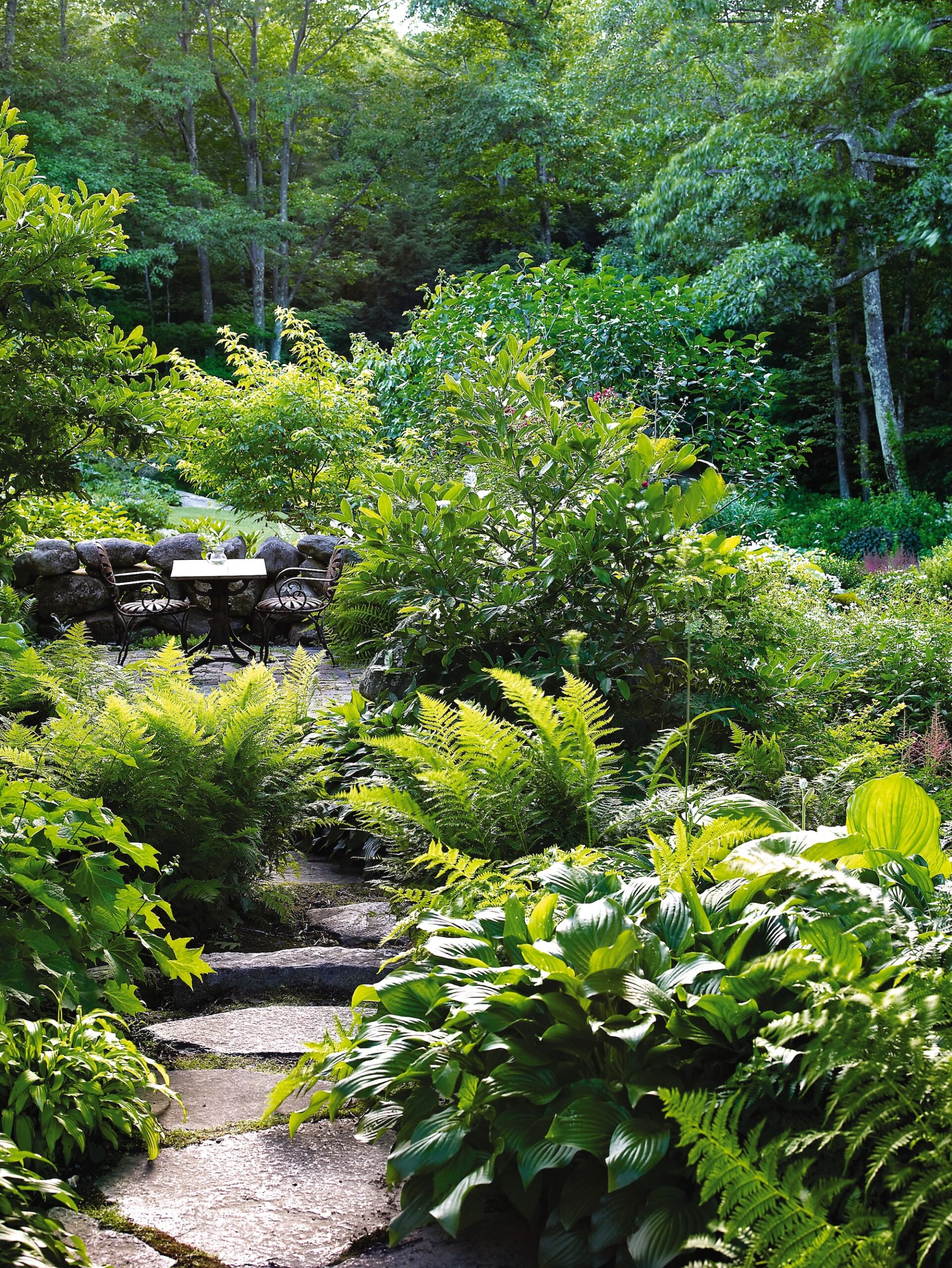
Photo by Eric Piasecki
Planning
Learn how to make the most of dimly lit areas in your own yard with favourite specimens and planting tips.
Choose the plants
Browse the “shade plant” section at nurseries and online, and keep the following considerations in mind when picking specific specimens.
- Plants that thrive in shade have larger leaves for taking in as much light as possible. Those that can tolerate full shade (as noted on the plant tag) can be planted in the deepest, darkest nooks and crannies.
- Foliage may reign supreme, but it’s worth including flowering species that tolerate shady conditions, such as Spanish bluebells, bleeding hearts, Hosta ‘Francee’, and Hosta ‘Fire and Ice’.
- Because it is easy for shade gardens to be awash in green, look for opportunities to throw in rich, dark purples, such as wild violets or Virginia bluebells, or glowing white blooms, like woodland phlox or foamflower.
- As always, choose plants with different flowering windows, from late-winter/early-spring ephemerals and spring ornamental trees through late-summer/autumn perennials and shrubs.
At Brandywine, spring bloomers include red Helleborus ‘Brandywine’ and Narcissus ‘Ice Follies’. In summer, the terrain features the camellia-like white petals of the Stewartia koreana tree, the variegated foliage of Hakonechloa macra ‘Aureola’, a dark patch of heuchera, the vivid hues of Hydrangea quercifolia and serrata, and yellow Corydalis lutea, which covers the wall. Come autumn, the colourful landscape includes reddish Rhus sumac, magenta Cornus florida, yellow Magnolia macrophylla, and white ghost bramble (Rubus cockburnianus).
- Hostas and ferns are quintessential, easy-care shade options. Both come in a dazzling array of forms and shades, including the painted Japanese fern, which sports silvery fronds with purple down the centre; ostrich ferns, whose plumelike, arching fronds are reminiscent of tail feathers; and ‘Francee’ hosta, with dark-green, heart- shaped leaves with white margins and midsummer blooms. Two hosta hybrids—‘Blue Umbrellas’ and ‘Blue Angel’—are drought-tolerant summer stars.
- Choose plants with contrasting appearances— even (or especially) when using just one species. For example, the starry white flower of Allium ursinum, also known as bear’s garlic, looks lovely with purple heuchera (Heuchera ‘Plum Pudding’) and twinleaf (Jeffersonia diphylla, a native perennial named for Thomas Jefferson). Golden hakone grass (Hakonechloa macra ‘Aureola’) combines beautifully with hostas and Solomon’s seal.
- Layer the plants by height and also by color—brighter varieties can pop in the darkest depths.
Pick the site
Look for areas with dappled shade, which can accommodate a greater plant selection and allow you to create a woodland effect. Deeper shade will require more careful selection but can be even more dramatic and moody in a good way.
- Natural locations for shade gardens include under the canopies of deciduous trees and in the shadow of thick evergreens.
- No trees? Try the north-facing side of a house or other building and beneath pergolas or arbors covered with climbing plants.
Plot the design
No matter the size, shade gardens typically follow a few general style principles.
- Because they are usually inspired by nature, consider incorporating mass plantings of the same varietal to replicate how many understory plants grow in colonies or stands.
- You can even create a “stream” of different painted ferns along with colorful flowers like Epimediums in a woodland garden.
- Stone walls are another common feature—such as the 300-foot-long rubble wall (built with stones collected from the landscape) containing Brandywine’s shade garden. Choice plants grow along this wall and beside paths that wend throughout the hillside.
- Pathways are the backbone of larger-scale shade gardens, inviting contemplative strolling, like the mossy brick walkway below, flanked by tall hornbeam hedges and low-growing pale-hued ferns and bright hostas.
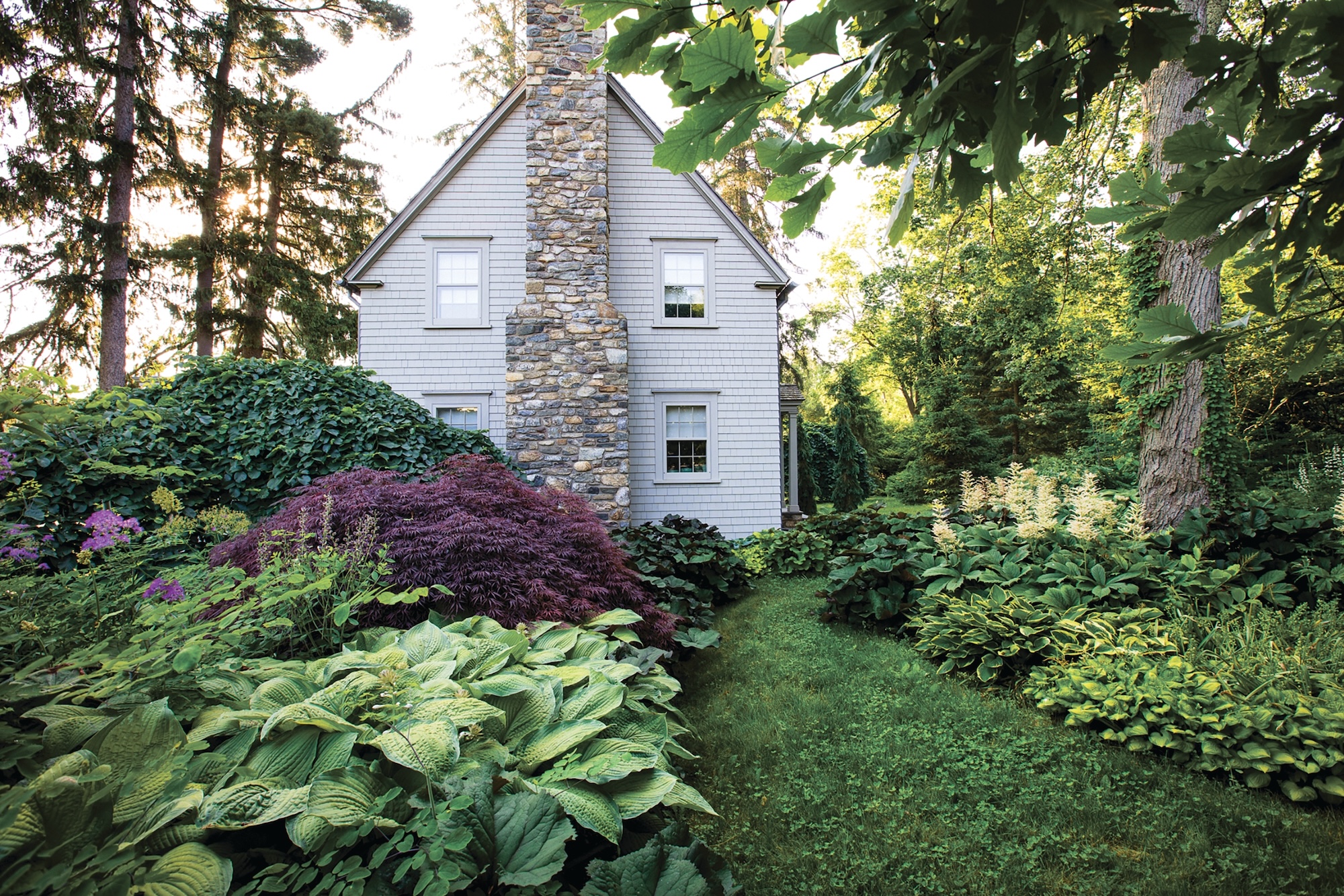
Brandywine Cottage. Photo by Claire Takacs
Shade plants by season
The following specimens are just some of those to incorporate into your own landscape, including those shown here.
Spring
- Lady’s slipper orchid (Cypripedium ‘Gisele’)
- Rue anemone (Anemonella thalictroides)
- Spanish bluebells (Hyacinthoides hispanica)
- Bleeding heart (Lamprocapnos spectabilis)
- Barrenwort (Epidemium)
- Eastern redbud (Cercis canadensis)
- Hellebore (Helleborus)
- Snowdrop (Galanthus)
- Yellow trillium (Trillium luteum)
Summer
- Black mondo grass (Ophiopogon planiscapus ‘Nigrescens’)
- Hosta such as ‘Francee’ and ‘Fire and Ice’
- Japanese forest grass (Hakonechloa macra ‘Aureola’)
- Japanese painted fern (Athyrium niponicum ‘Pictum’)
- Oakleaf hydrangea (Hydrangea quercifolia)
Autumn
- American euonymus (Euonymus americanus)
- Aromatic aster (Aster oblongifolius)
- Bowman’s root (Gillenia trifoliata)
- White wood aster (Aster diaricatus)

Martha Stewart’s Gardening Handbook: The Essential Guide to Designing, Planting, and Growing by Martha Stewart
Published by HarperCollins
Buy Now